Category: Magazin

  • Series #18: Key technologies for industrial AI and robotics in NRW

    Series #18: Key technologies for industrial AI and robotics in NRW

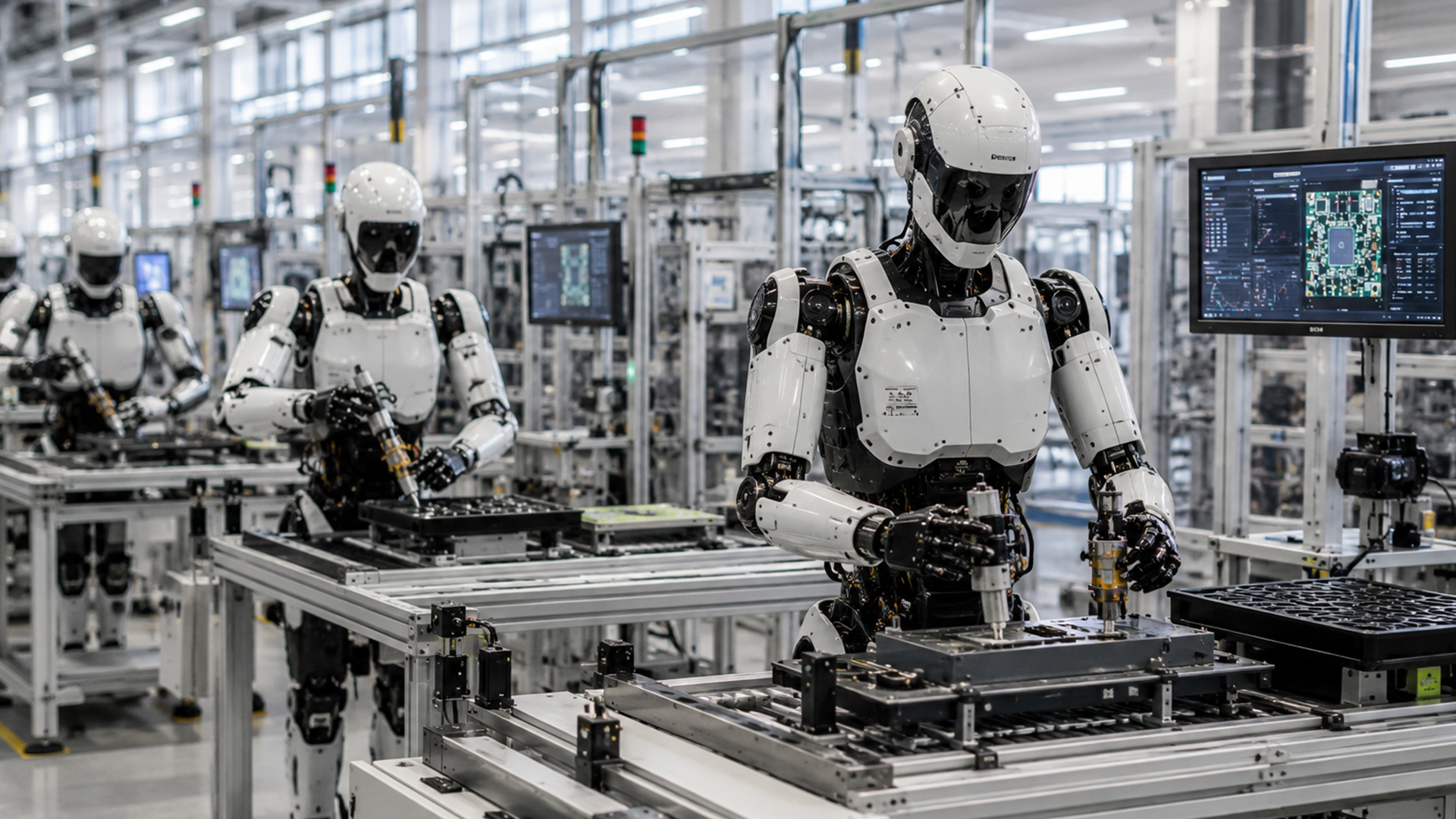
    Industrial AI and robotics are key technologies for North Rhine-Westphalia as a hub for high-tech and manufacturing. They enable more efficient, flexible, and resilient processes, boost productivity and quality, and help address the shortage of skilled workers.

    Their potential stems from the interplay of AI, sensor technology, actuator technology, edge and cloud computing, semiconductors, data spaces, digital twins, and modern communication and automation technology. This gives rise to adaptive robots, cobots, autonomous systems, and intelligent machines that perceive and evaluate their environment and act autonomously.

    Our magazine, “Key Technologies for Industrial AI and Robotics,” showcases the expertise landscape in North Rhine-Westphalia—from development and research through system integration to industrial applications. We are seeking real-world examples, research projects, technologies, and collaborations from North Rhine-Westphalia that highlight innovation, technology transfer, and industrial value creation.

    Submit your suggested topic now

      Salutation (required)

      First Name (required)

      Company/Institution

      Email (required)

      Note: After submitting the form, you will receive an email to confirm your email address. Please also check your spam or junk folder. We can only process your request after you have clicked the confirmation link contained in the email.

    • Series #19: NRW builds on high-tech: innovations in the construction and building materials industries

      Series #19: NRW builds on high-tech: innovations in the construction and building materials industries

      The construction and building materials industry is a key sector for value creation and transformation in North Rhine-Westphalia. It lays the foundation for housing, mobility, energy supply, and industrial infrastructure. At the same time, it faces the challenge of significantly reducing resource consumption and greenhouse gas emissions, closing material cycles, and becoming more productive, resilient, and competitive despite cost pressures and a shortage of skilled workers.

      Key drivers come from high-tech developments: New materials and resource-efficient manufacturing processes are converging with sensor technology and photonics, microelectronics, artificial intelligence, robotics, digital twins, additive manufacturing, and modern recycling technologies. Working together, they enable lower-emission and higher-performance building materials, data-driven production and construction processes, automated construction sites, more durable infrastructure, and new circular business models.

      With the magazine “NRW Builds on High-Tech: Innovations in the Construction and Building Materials Industry,” we showcase North Rhine-Westphalia’s technological expertise and innovative strength across the entire value chain—from materials research and building materials production through planning and construction to operation, demolition, and recycling. The focus is on groundbreaking technologies, real-world examples, research and technology transfer projects, as well as successful collaborations between industry, academia, and end users.

      We are looking for submissions from North Rhine-Westphalia that demonstrate how key technologies are driving the transition to a resource-efficient, climate-friendly, and competitive construction industry and enabling new value creation.

        Salutation (required)

        First Name (required)

        Company/Institution

        Email (required)

        Note: After submitting the form, you will receive an email to confirm your email address. Please also check your spam or junk folder. We can only process your request after you have clicked the confirmation link contained in the email.

      • Hydrogen for structural change in NRW

        Hydrogen for structural change in NRW

        In North Rhine-Westphalia, hydrogen has long since evolved from a promise for the future into a concrete opportunity for industrial policy. The latest issue of NMWP.NRW magazine shows how political framework conditions, infrastructure, and technological innovations work together to enable new applications and make hydrogen-based value creation a reality in North Rhine-Westphalia.

        In an interview with Minister of Economic Affairs Mona Neubaur, it becomes clear how closely climate protection and competitiveness must be considered together. Accordingly, efficiency, renewable energy, and climate-friendly technologies are not a cost factor but rather a locational advantage—provided that investments can be planned, regulations are practical, and funding is targeted effectively. At the same time, hydrogen should be used where it is indispensable, while direct electrification may be faster in other areas. Equally central is the role of networks and clusters, which bring stakeholders together and accelerate knowledge transfer.

        Through our collaboration with the Wasserstoff Hub Rhein-Kreis Neuss/Rheinland e. V., the magazine also focuses precisely on this intersection: Dr. Stefanie Kesting (Thyssengas) explains why the success of the H₂ core network depends on the regional “exits”—the connections that actually deliver hydrogen to businesses. Examples from North Rhine-Westphalia show how a partnership-based approach is driving momentum despite unresolved issues.

        Technologically, the magazine covers the spectrum from systems to components: from the concept of hydrogen as the “backbone” of a resilient energy system to concrete solutions in sensor technology, safety engineering, and combustion; in layers and coatings for electrolysis and fuel cells; and in materials science questions regarding “hydrogen compatibility.” This makes it clear how nano- and microtechnologies, new materials, and photonics directly contribute to scaling and industrial application.

        The prospects for implementation are also examined: The H2HS project in Heinsberg illustrates regional, integrated value creation—from production and storage to application in transportation—that is scalable and compatible with other sectors. Other articles show that the ramp-up is not failing due to a lack of ideas, but rather because of the challenge of bringing technology into mass production and expanding infrastructure across the region.

        NMWP.NRW Magazine #17 is intended as an invitation: to contribute ideas, to network, and above all, to take action. North Rhine-Westphalia brings industrial density, research, and a culture of innovation to the table to build hydrogen value chains and shape structural change as an opportunity.

      • Key technologies from NRW for the security and defense industry

        Key technologies from NRW for the security and defense industry

        The security and defense industry has been an integral part of the NMWP.NRW cluster for many years as a key application area for our core technologies—nanotechnology, nano- and microsystems technology, innovative materials, and photonics. Much like the automotive industry, medical technology, or aerospace, this field is also closely intertwined with the technological developments of our community.

        When we decided to place a visible emphasis on the security and defense industry in our work, the response still surprised us. Despite the high economic relevance of this field in North Rhine-Westphalia, the momentum was unexpected: The themed evening “High-Tech Production and Innovative Materials for Aviation,” organized jointly with AeroSpace.NRW and Rheinmetall Aviation Services in April 2024, was fully booked after just two days—as was the follow-up event “High-Tech from North Rhine-Westphalia for the Security and Defense Industry” in February 2025.

        This magazine explores these trends and highlights exemplary developments that underscore the capabilities of North Rhine-Westphalia’s industrial sector. For example, articles on industrial computed tomography demonstrate how non-destructive testing methods can meet the highest quality standards in the defense sector. Drone technologies from Arnsberg illustrate the role of modular, lightweight systems in reconnaissance and disaster response. Textile innovations such as metal-coated fibers open up new possibilities for protection and resilience in aerospace and defense. Carbon fiber approaches for sustainable high-performance materials, ceramics for personal protection, and the systematic testing and evaluation infrastructure for electromagnetic warfare also illustrate just how broad and application-oriented NRW’s expertise is.

        In addition to these technological insights, we would like to draw particular attention to two interviews that clarify the strategic framework: Mona Neubaur, Minister for Economic Affairs, Industry, Climate Protection, and Energy, describes the responsibilities and opportunities that North Rhine-Westphalia faces in a changing security policy environment. Dr. Hans C. Atz-Podien, CEO of the BDSV, highlights how small and medium-sized enterprises in North Rhine-Westphalia can contribute their expertise to the defense industry’s value chains and thereby strengthen Europe’s defense capabilities.

        The latest issue of NMWP.NRW magazine makes it clear: North Rhine-Westphalia not only boasts technological excellence, but also a unique ecosystem of large corporations, small and medium-sized enterprises, and research institutions that are working together to develop solutions for the future. Our goal is to highlight this innovative strength and to further strengthen the bridge between technological development and security-related applications.

      • Future of Computing

        Future of Computing

        In our increasingly complex world, it is digitalization that provides us with vital support—from the countless little helpers in our daily lives to highly complex computing infrastructures. When we take a closer look at digitalization, we must distinguish between software and hardware. Innovative hardware plays a central role, as it is what makes many applications—such as artificial intelligence and machine learning—possible in the first place. Through disruptive approaches in computer hardware, we strengthen our international position as a hub for innovation and thereby unlock market potential at the national, European, and global levels. After all, if data and software were considered oil, innovative computer architectures would be the derricks.

        Key technologies such as nanotechnology, nano- and microsystems engineering, innovative materials, and photonics are of central importance in innovative computer architectures. These technologies provide important impetus along the entire value chain—from new 2D materials and photonic components, through corresponding production processes such as electron beam lithography, to complete systems such as neuromorphic chips. In particular, key technologies from North Rhine-Westphalia make a fundamental contribution at various levels in the field of nano- and microsystems engineering to increasing resource efficiency, energy savings, the transition away from fossil fuels, and resilience. Hardware and software thus jointly serve as the driving forces behind the advancements we see, for example, in sectors such as healthcare, education, energy, transportation, and logistics, as well as in enhancing the resilience of critical sectors of our economy and infrastructure.

        North Rhine-Westphalia is home to remarkable economic and scientific activities in the fields of neuromorphic computing, high-performance computing, modular supercomputing, edge computing, and quantum computing. These innovative technologies and hardware innovations—alongside the training of highly qualified specialists—emerge from a well-functioning and well-connected ecosystem comprising science, business, and politics.

        In an interview with NMWP.NRW, Ms. Ina Brandes, Minister of Culture and Science for the State of North Rhine-Westphalia, attested to the high innovation potential of our economic and scientific landscape. The high concentration of excellent research, in particular, provides important international impetus through scientific discoveries and economically successful spin-offs.

        As you can see, key technologies such as nano- and microsystems engineering, innovative materials, and photonics are important enablers for the “Future of Computing.” These cross-cutting technologies are our daily companions and supporters. They are hardly noticed by the general public, yet they make indispensable contributions to improving our lives and strengthening the economy in a sustainable way. With this magazine, we would like to offer you insights into some of the activities and innovative initiatives coming out of North Rhine-Westphalia.

      • Key technologies in the car of the future

        Key technologies in the car of the future

        The automotive industry is currently undergoing a fundamental transformation. Although this transformation poses significant challenges for entire value chains—from automakers to the supplier industry and on to materials research—it also offers a wide range of opportunities. And as in nearly all markets, key technologies offer fundamental solutions in a wide variety of areas. To highlight a few examples of innovative drivers for the mobility transition, the NanoMikroWerkstoffePhotonik.NRW cluster, in collaboration with the automotiveland.NRW cluster, has decided to dedicate a magazine to the topic of “Key Technologies in the Car of the Future.” The response from North Rhine-Westphalia’s high-tech community was so overwhelming that we can only include a few examples and cannot cover the full spectrum. Nevertheless, we are confident that we have been able to identify a few exciting developments for you as well.

        One of the key technologies, for example, is digitalization—an important and universal tool of our time. Supported by software and hardware—and brought together through digitalization—it is playing an increasingly vital role in our economy, not only in production but also, in the future, in planning and management processes. The car of the future is expected to be not only more environmentally friendly but also smarter. The sensor technology that already supports us today in driver-assistance systems will enable autonomous driving in the future. However, this will increase the overall demand for semiconductors in automobiles, as—in addition to sensors and actuators—good connectivity to the outside world and the ability to communicate and entertain will play an increasingly important role in purchasing decisions. Read the interview with Prof. Dr.-Ing. Peter Burggräf, Chair of International Production Engineering and Management (IPEM) at the University of Siegen.

        In addition to digitalization and sensor technology, material innovations are a key topic in the business world. After all, 70 percent of all technical innovations in Germany are based on material innovations. Innovative materials are closely linked to new production processes. Here, too, the speed at which components are becoming not only more high-performance but also lighter is impressive. Thanks to innovative approaches, 3D printing and custom-shaped, functionalized glass surfaces are finding their way into mass production. Without material innovations, the energy density required for electric mobility in batteries cannot be achieved. But recycling must not be overlooked either, as it is key to increasing resource efficiency as well as the resilience of North Rhine-Westphalia’s economy. In this regard, we are proud to present to you in this magazine “cylib,” the battery recycler from Aachen that won this year’s NRW Innovation Award.

        In an interview with NMWP.NRW and automotiveland.nrw, Ms. Mona Neubaur, Minister of Economic Affairs, Industry, Climate Protection, and Energy for the State of North Rhine-Westphalia, attested to the high innovation potential of our economic and scientific landscape. For sustainable mobility, we need clean cars, and key technologies are indispensable for this. The NRW Minister of Economic Affairs emphasizes that it is important for us to possess and continue developing the expertise for these key technologies in North Rhine-Westphalia.

        As you can see, key technologies such as nano- and microsystems technology, innovative materials, and photonics are important enablers for the automobile of the future. They are rarely noticed by the general public, but they make indispensable contributions to improving our lives and strengthening the economy in a sustainable way. With this magazine, we would like to offer you insights into some of the activities and innovative initiatives coming out of NRW.

      • Photonics from NRW

        Photonics from NRW

        Photonics is not only one of the oldest key technologies in existence, but it continues to provide cutting-edge impetus and innovations in nearly all fields of application and megamarkets. In fact, there is hardly a high-tech product today that has not been processed with a laser at least once during its manufacturing process. Modern chips cannot be manufactured without optical technologies, and “laser powder bed fusion” enables even the smallest structures to be 3D-printed with maximum efficiency. High-speed data connections—which are essential for digitalization—would also be impossible without photonics.

        Europe’s photonics industry ranks second globally, behind China. In Germany, too, the photonics industry is experiencing strong growth. With approximately 1,000 manufacturers of photonic components, 161,000 employees, and annual revenue of about 40 billion euros, this sector accounts for roughly 40 percent of Germany’s total business in Europe.

        North Rhine-Westphalia (NRW), as one of Germany’s key high-tech hubs, is also exceptionally well-positioned in the field of photonics. For this reason, we have decided to use this issue of our NMWP magazine to highlight the breadth of photonics in NRW through a few examples. Whether it’s innovative solutions for securing green energy through efficient hydrogen production or sustainable resource conservation through new, laser-based production processes using AI and neural networks, high-resolution 3D sensing is used in quality control, healthcare, and autonomous driving. Furthermore, photonics serves as an alternative for miniaturization in the chip industry. North Rhine-Westphalia’s excellent research landscape and its numerous innovative companies are the driving force behind innovative solutions “made in NRW.” This makes photonics an important pillar for us in ensuring competitiveness and prosperity.

        In our interview, Dr. Lutz Aschke, President of Photonics21, shares interesting insights and personal perspectives on photonics in Europe and Germany, as well as on the challenges companies currently face due to geopolitical developments. Addressing the shortage of skilled workers and creating a growth-promoting environment for startups are other key areas in which networks such as Photonics21 and NMWP.NRW are active.

      • Key technologies from NRW as enablers for future digital and computing concepts

        Key technologies from NRW as enablers for future digital and computing concepts

        Digitalization is an important and universal tool for solving a wide variety of challenges of our time. It involves not only software but also innovative hardware concepts with significantly enhanced performance. These enable us to solve increasingly complex problems and address ever-more-complex issues. Thus, software and hardware—united through digitalization—make fundamental and important contributions to the economy, science, and society. They also provide innovative impetus on a global scale for addressing cross-border issues. We at NMWP.NRW focus in particular on innovative hardware and modern electronics. As a high-tech hub, North Rhine-Westphalia (NRW), with its comprehensive economic and scientific expertise in the field of hardware, is playing a key role in shaping the global economic transformation.

        For example, new architectures in chip development based on RISC-V offer novel approaches to AI-based sensor technology at the European level. Quantum computing and neuromorphic chips will enable new areas of application for artificial intelligence through significantly increased computing capacity combined with reduced energy consumption. This will lead to innovations across all industrial sectors, thereby securing economic growth, employment, and prosperity in NRW.

        Digitalization is making inroads into ever more areas of our lives. Not only in logistics or as sensor technology for predictive maintenance, but also in medical wearables, state-of-the-art processors contribute to health monitoring and, thereby, to greater well-being and a healthier life. Similarly, sensor technology, in combination with efficient chips, provides insights and an overview for designing sustainable cities and increasing agricultural yields. This holds great potential for tackling global challenges such as poverty and hunger, as well as for reducing environmental impact. The vast amounts of data collected and processed in this way are transmitted significantly faster thanks to THz photonics with 6G. This brings business locations and people closer together.

        The digital twin, as a digital representation of, for example, production lines, offers insights into processes with the highest resolution. This reveals opportunities for optimization and allows changes in processes to be simulated. Last but not least, quantum computing will offer solutions in the future for problems that are currently unsolvable, for example in the areas of process optimization or material optimization.

        As you can see, key technologies such as nano- and microsystems engineering, innovative materials, photonics, and quantum technologies are important hardware enablers for future digital and computing concepts. Although they receive little public attention, they make indispensable contributions to improving our lives and strengthening the economy. With this issue of our magazine, we’d like to offer a brief glimpse into some of the activities and contributions in these fields from North Rhine-Westphalia.

      • Key technologies in NRW’s circular economy

        Key technologies in NRW’s circular economy

        “We promote the circular economy as an effective means of protecting the climate and conserving resources, and as an opportunity for sustainable economic development and job creation.” This is the new federal government’s commitment to this important issue as stated in the current coalition agreement.

        However, it is not only in the federal government’s coalition agreement but also in the new innovation strategy of the state of North Rhine-Westphalia that “innovative processes, manufacturing methods, alternative materials, products, and services for greater resource efficiency and effectiveness, as well as improved circularity or recyclability (durable, robust, repairable, modular, free of harmful substances, single-material, recyclable)” are cited as key factors.

        In particular, developments in the field of new materials—addressed by the NanoMikroWerkstoffePhotonik.NRW cluster—as well as in the key technologies of nanotechnology, microsystems engineering, and photonics, and in digital technologies such as quantum computing, neuromorphic computing, and digital twins, are providing important impetus from North Rhine-Westphalia. As a result, they are becoming a key enabler for the further development of the world’s largely linear economic systems toward a circular economy. In the context of sustainable mobility, for example, the areas of battery manufacturing and recycling, lightweight construction, and clean energy generation play a central role.

        The shift toward a circular economy is important for nearly all industrial sectors, especially in North Rhine-Westphalia (NRW), one of Europe’s most important hubs for materials and high-tech industries. The COVID-19 pandemic, as well as the grounding of the cargo ship “Ever Given” in March 2021, have shown just how heavily we rely on international supply chains. These chains have been thrown into disarray and, in some cases, have come to a standstill. The result is supply shortages and massive price increases for raw materials such as silicon and aluminum, which are also being felt in B2B and B2C business and are jeopardizing our economic development as well as innovation processes in North Rhine-Westphalia, Germany, and Europe. Competitive material cycles could significantly mitigate these effects.

        Professor Dr. Andreas Pinkwart, Minister for Economic Affairs, Innovation, Digitalization, and Energy of the State of North Rhine-Westphalia, also emphasizes in an interview in this issue of NMWP Magazine: “Even if many price increases are merely temporary, one thing is certain: Many raw materials will remain scarce for the foreseeable future because production capacities cannot be expanded quickly enough or have been exhausted. The trend is therefore clearly toward significantly higher prices. This further increases both the necessity and the profitability of the circular economy, as demonstrated by a recent study conducted for us by the RWI. The pandemic has certainly been a major catalyst for this effect, but it is not the only cause.”

        This is why the circular economy is so important in industry: In addition to protecting the climate and conserving resources, it can help achieve a certain degree of independence from international markets and stability in a country’s own economic development.

        However, the challenges posed by the circular economy are multifaceted. Not only does the topic require interdisciplinary teams for implementation, but a fundamental shift in thinking is also necessary—not only in industry, but also in society.
      • HIGH-TECH.NRW

        HIGH-TECH.NRW

        As Germany’s leading materials and high-tech region, North Rhine-Westphalia makes a significant contribution to the competitiveness of the entire European Union in all key markets. However, this can only be achieved if business and academia in North Rhine-Westphalia continuously work hand in hand to develop new, innovative technologies, products, and services that not only secure and improve our future but also make a valuable contribution to addressing major global challenges, such as climate change and societal transformation. This requires perseverance, however, as high-tech innovations are often associated with high risk, significant effort, and substantial capital investment. When I develop something completely new, the market for it often doesn’t exist yet—because there’s nothing comparable available. Accordingly, it’s often startups that lay the foundation for such innovations, where their founders are driven by idealism and creativity to turn their ideas into success. For them, the (further) development of the innovation is the absolute priority.

        The NanoMikroWerkstoffePhotonik.NRW state cluster recognized early on the valuable contribution that founders make to the competitiveness and growth of North Rhine-Westphalia’s economy and has been specifically committed to supporting high-tech startups from the very beginning. The focus here is not primarily on financial support or the provision of technical infrastructure, as young entrepreneurs already receive this through specialized funding programs such as Exist, startup grants, or START-UP TRANSFER.NRW, or through access to technical infrastructure provided by universities. What these creative minds often lack, however, is access to markets and experience in establishing market-ready production processes. Open dialogue with mentors and seasoned entrepreneurs in the high-tech sector, access to pilot customers, and contact with potential investors open up entirely new perspectives—and a new world in which one must first find one’s bearings. These first steps into the business world are often the most important—they are largely responsible for the success or failure of the young company. For this very reason, the NMWP.NRW cluster specializes in providing support during this phase of startup development.

        So even though this topic is nothing new to us, it was the PilotAction of the Interreg Europe project “STEPHANIE” that took these activities to a new level with the “HIGH-TECH.NRW” accelerator—with great success. The feedback from the business, academic, and political communities, as well as from the participating startups, was extremely positive, so we’ve decided to give you a glimpse into the accelerator in this issue of NMWP Magazine—and, above all, to introduce you to these highly innovative young companies.